HARMONY — the seven levers
Run it the way a pilot runs a checklist — before the event, not at the barricade.
See people, and let them know they are seen. Name the roles a gathering depends on and usually ignores — the sweeper, the nurse, the constable, the volunteer. Dignity made audible is the cheapest and most powerful thing a state can offer a crowd.
Give the gathering a purpose larger than itself. People who are reaching for something — a medal, a record, a cleaner city, a fair shot for their child — do not riot; they compete, build, and cooperate.
Make it repeat. A gathering that happens once is an event; one that happens every Sunday is a relationship. The crowd that knows what to expect from you, and finds you keep your word, is a crowd you will never have to charge.
Use rhythm and shared emotion — literally and figuratively. Synchrony turns a thousand strangers into one breathing "we". A crowd singing together is not a crowd looking for a fight.
Design the structure and the flow — and treat this as the safety lever, not the control lever. Clear signage, visible queues, marked routes, room to move. Order is not the boot on the neck; it is the staircase that keeps the crush from forming.
Give people a story they can inhabit. A crowd always tells itself a story about why it is there; if you do not supply a generous one, rumour will supply a poisonous one.
Give ground on purpose — space, time, a small concession — to keep the larger peace. Yielding an inch is not surrender; it is authority exercised with judgement. The leaders who cannot yield an inch are the ones who lose the mile.
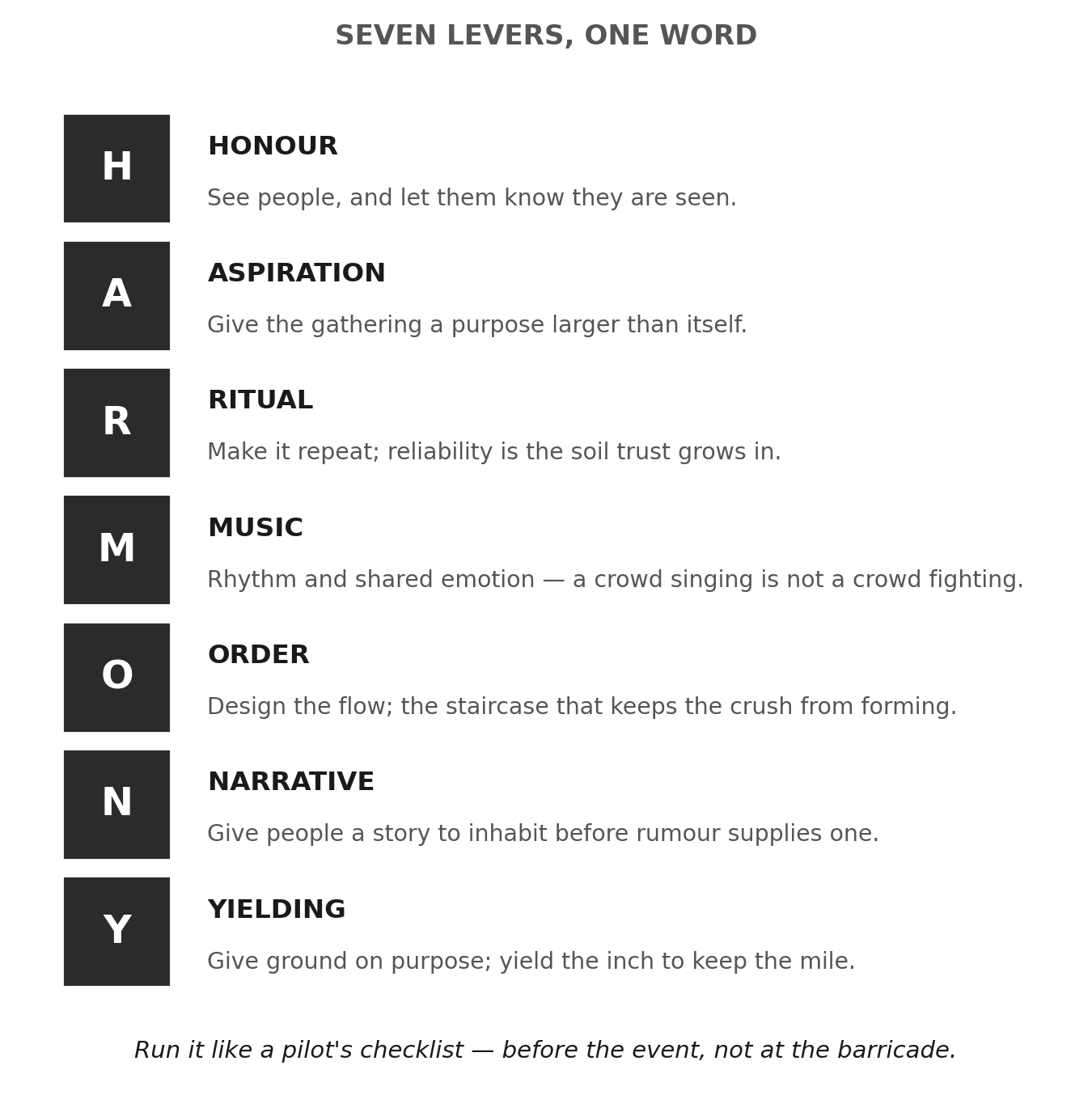
Seven levers, one word. None of them is a trick to placate a crowd; together they are a way to design a gathering that does not need placating.
The five gauges — and the two clocks
Watch all five; it is their combination, not any one alone, that is dangerous.
- The blocked generation. High youth unemployment; a generation more qualified than its economy can absorb. This is the dry timber.
- The grievance backlog. Rising prices, visibly decaying services, corruption watched in real time. This is the kindling.
- The legitimacy deficit. Falling trust in institutions; no channel for dissent the public believes in. This is the missing safety valve.
- The trigger conditions. A recent injustice that can crystallise the anger — and a track record of meeting protest with force. This is the box of matches.
- The wiring. Deep social-media penetration, a young population on the networks, a history of shutdowns. This is the wind.
The scorecard — score each low · medium · high
- Are large numbers of our young educated, connected, and without prospects?
- Are the costs of daily life outrunning incomes, and are services visibly failing?
- Is corruption both widespread and visible — and do people believe nothing is done about it?
- Do people have a real, trusted way to be heard between elections?
- Has there been a recent injustice that could become a rallying cry — and do we have a reflex of meeting protest with force?
- Is our population young, heavily online, and has it watched us reach for the off-switch before?
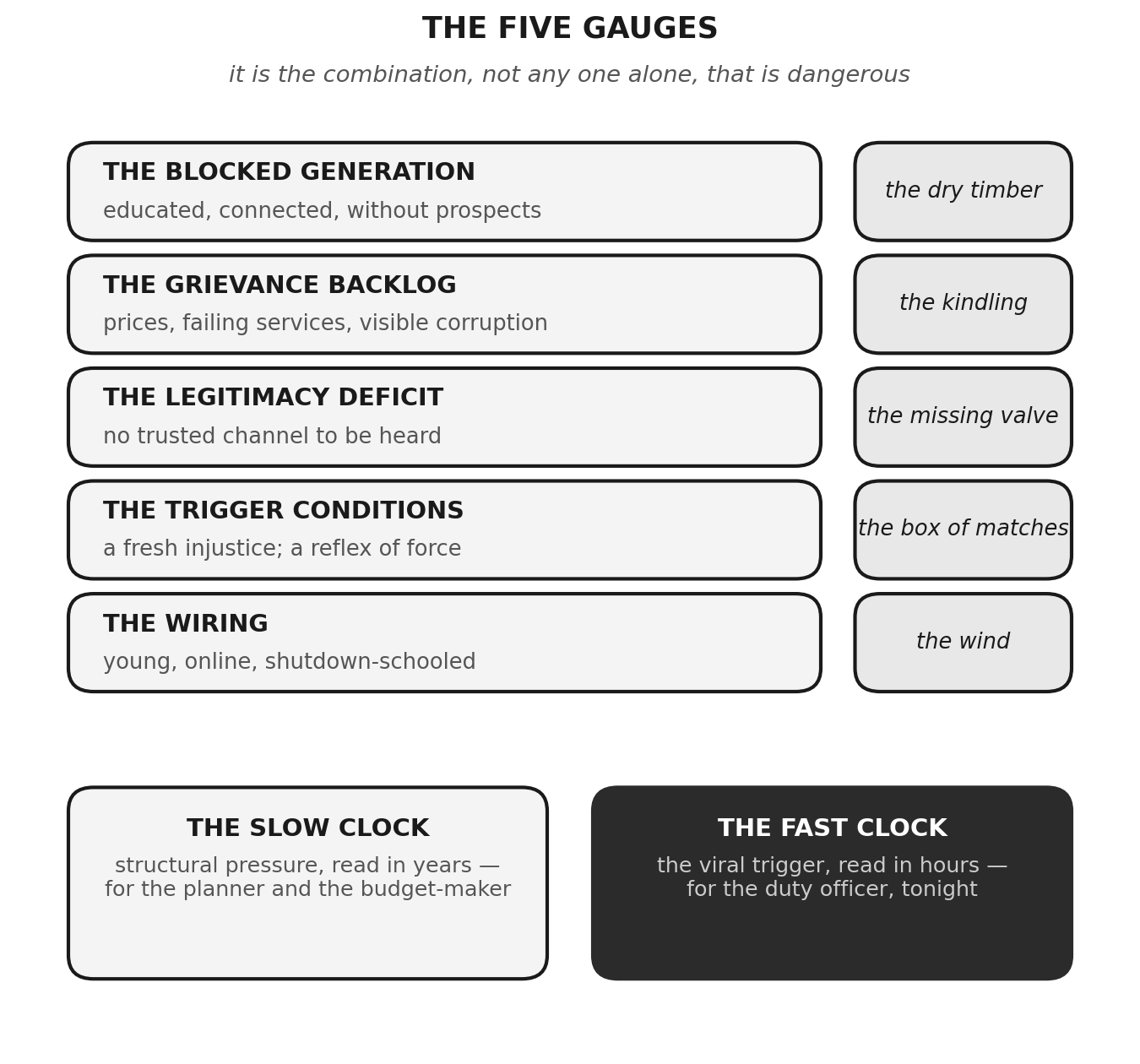
Two clocks. The five gauges measure slow risk — whether the house is full of gas. The match belongs to a faster clock: a triggering injustice going viral, a death acquiring a face and a hashtag, calls to converge, a rumour outrunning the truth. A wise state watches both dials.
The first 72 hours
When it has already begun, the clock is the doctrine.
Deal with the handful who came to fight; do not charge the many who came out of grief.
Your own channel posting updates at short intervals, riding the same hashtags the fury is using, so the public always has somewhere true to look.
Visible action that answers the wound — on the street and on the screen at once.
Justice at a speed the public can believe in, done and said — not announced as an intention.
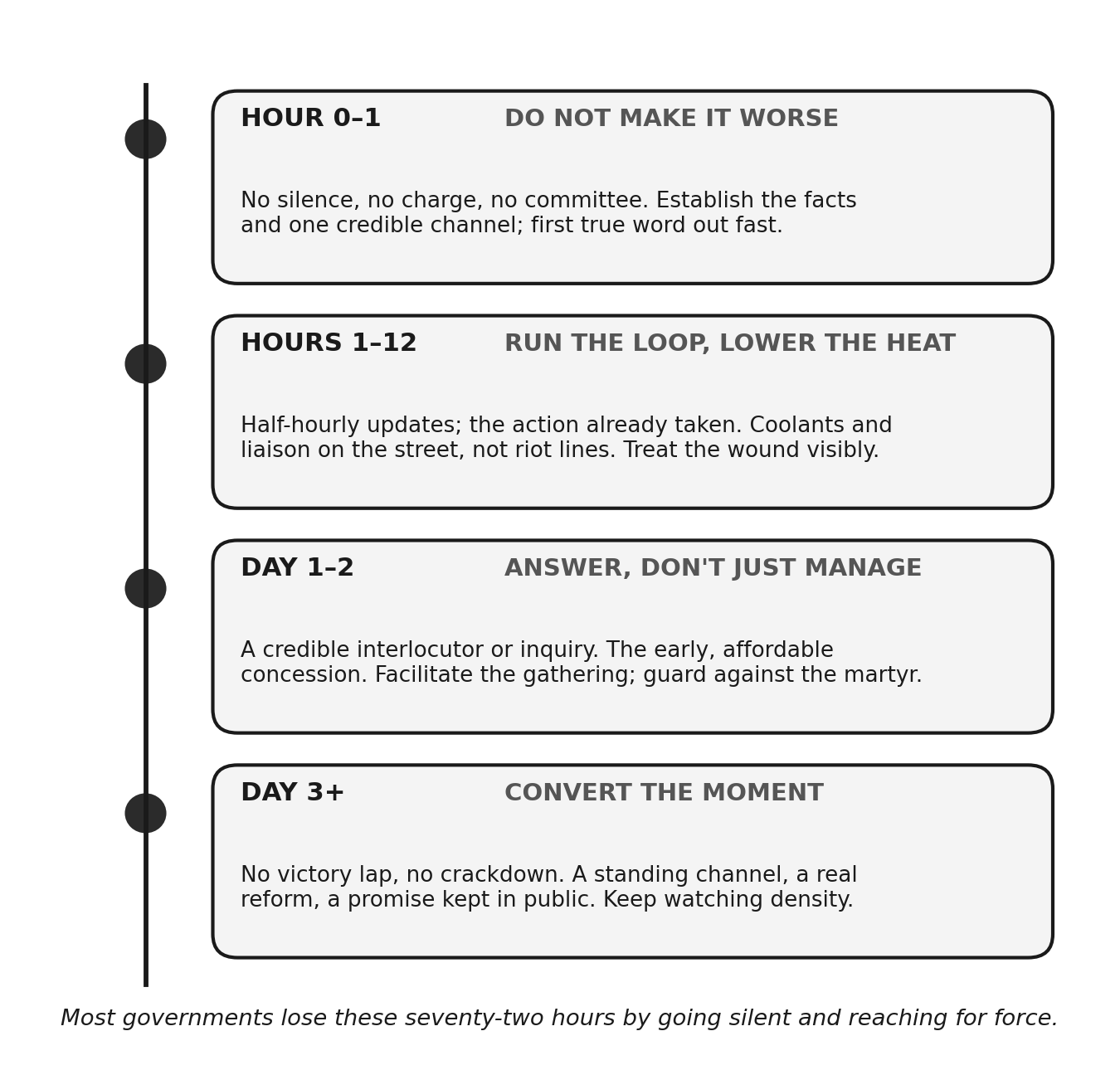
It has been done: a murder on 26 October 2020; the chargesheet on the eleventh day; conviction in month five, life sentences two days later. The fury was answered rather than crushed — and it subsided.
The ladder the law gives you
The law of crowd control, properly read, is not the enemy of this approach. It is this approach, written into the statute.
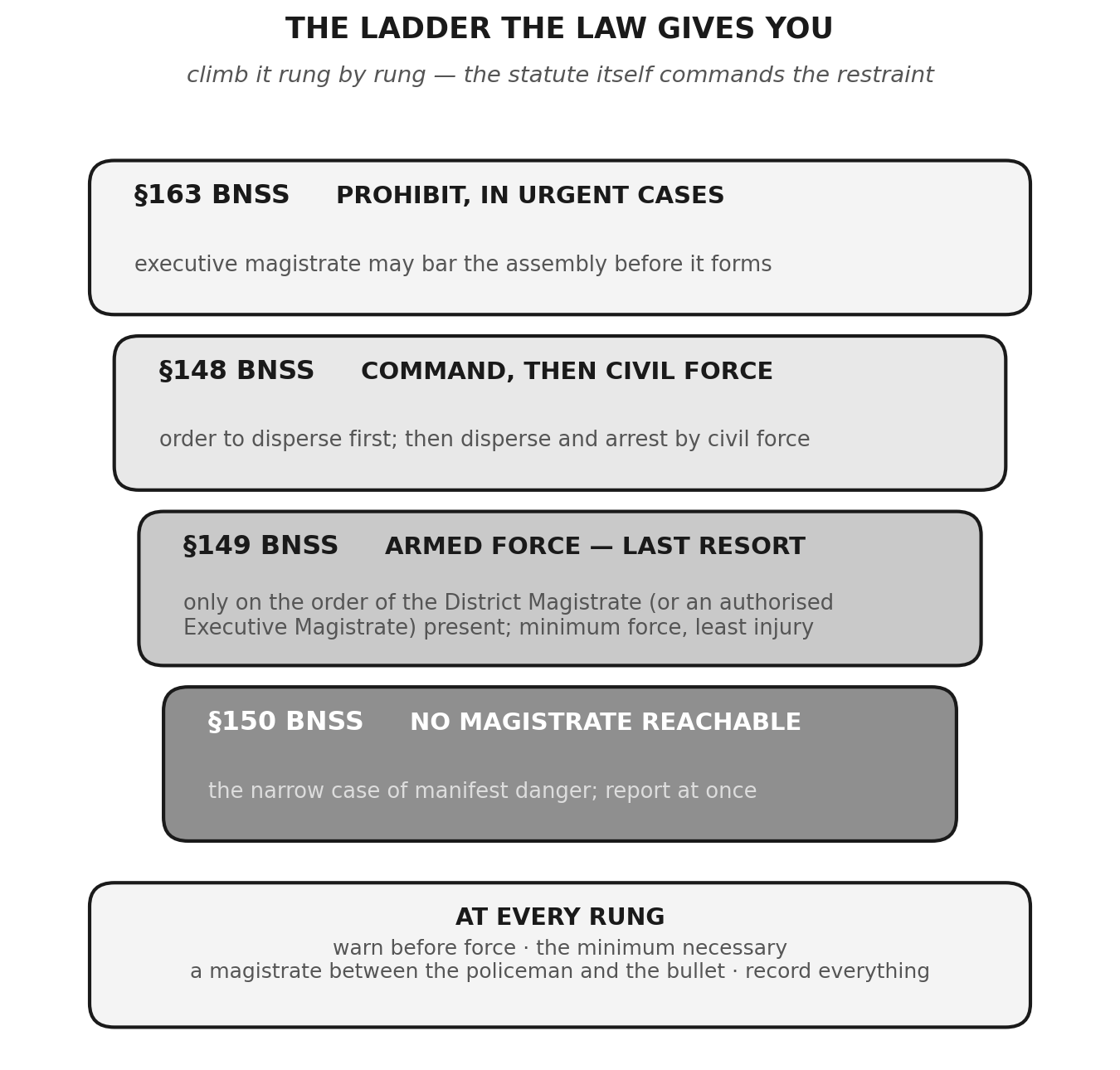
What the framework commands, what it forbids, and how — rightly understood — it protects the officer who follows it. The full chapter, The Law in Your Hand, is in the book.
Density & the crush
The least glamorous instrument in the box — and the one that has saved the most lives.
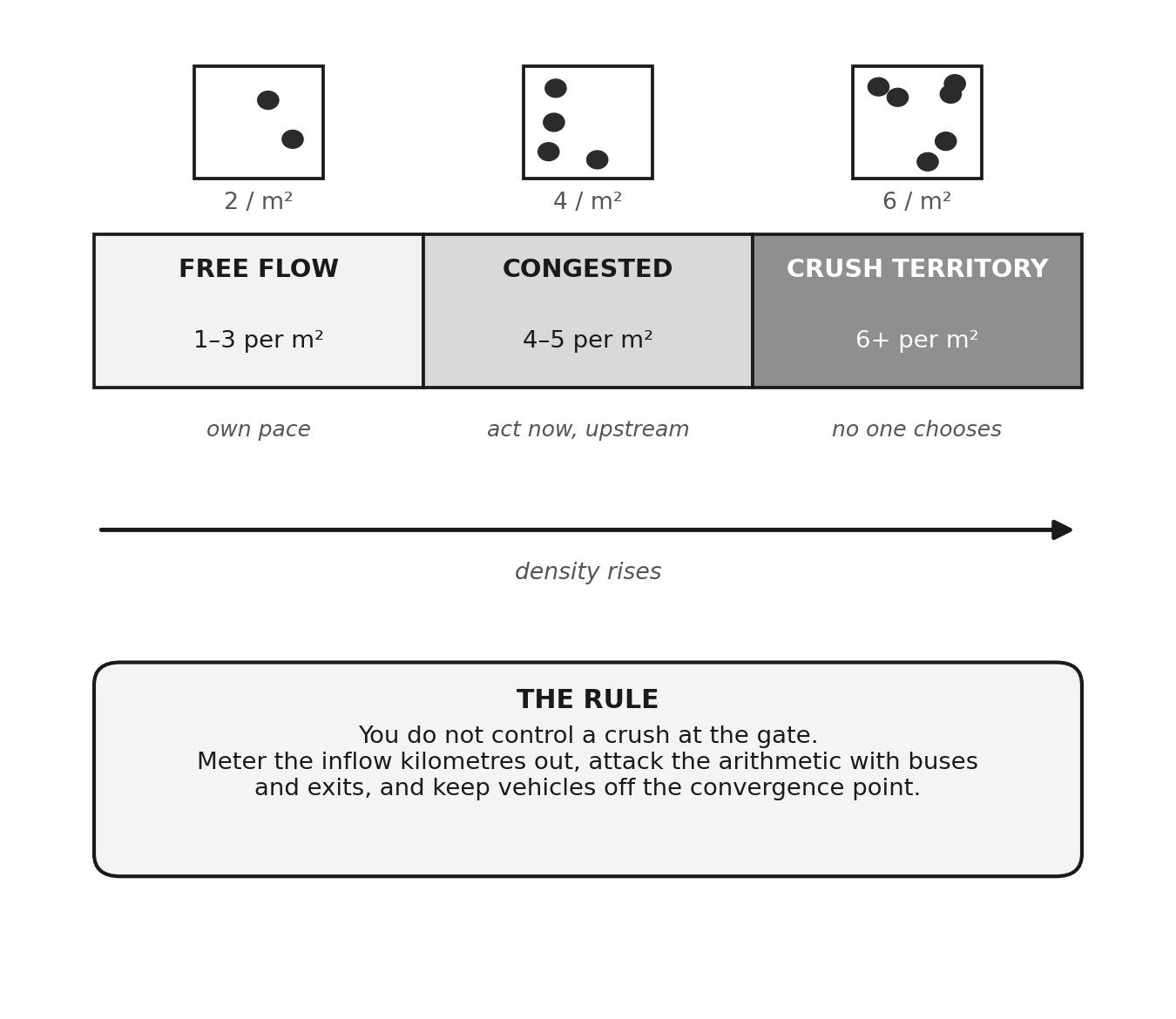
- Up to 2–3 per square metre — a crowd flows freely and adjusts itself.
- 4–5 / m², standing — tight, but survivable.
- 4–5 / m², moving — already an emergency: flow has broken and the pressure has nowhere to go.
- 6 / m², standing or moving — crush territory: the pressure of bodies — not the will of any individual — can lift people off their feet and squeeze the breath out of them while they are still standing.
The tool is design
- Count the density.
- Separate the entries from the exits.
- Break a great mass into smaller cells with breathing room between them.
- Watch the choke points — the gate, the bridge, the narrowing lane.
- Relieve the pressure before it builds, not after — because after is measured in funerals.
People do not die because they panic; they panic because they are dying. They are not animals reverting to instinct — they are people in a machine that someone built wrong.